

9-Point Time
The 9-Point Time Stamping System
Every 0REI seal carries three things together: when it was made, what it holds, and who signed it. Each one is proven by math and by outside witnesses, so nobody has to take 0REI's word for it.
One architecture: time, privacy and keys
- Points 1 to 6
- Establish the time.
- Point 7
- Keeps contents private while still proving totals.
- Point 8
- Keeps the signing keys trustworthy over years of rotation.
- Point 9
- Lets anyone check all of it, offline.

Two outside proofs
The 9-point system places every seal between two kinds of outside proof:
- "Not before": proof the seal couldn't have been made before a certain moment.
- "Existed by": proof the seal already existed by a later moment.
Together they give each seal a tight time window that independent outside parties vouch for. No single company, including 0REI, is trusted on its own for the time.
Why it matters
A clock on any one company's server is a time that company states about itself. 0REI records its own microsecond time in every seal (signed_at) and then backs it with outside witnesses. Binding each seal to an outside "existed by" receipt is what stops anyone holding a stolen key from backdating a seal to before that key was revoked.
The nine points
| # | Point | What it does | Role |
|---|---|---|---|
| 1 | The Time Pocket | A live bundle of outside time values: drand, NIST Beacon, Roughtime and 0REI's NIST-synced clock. | "Not before" |
| 2 | The Seal | Pedersen box, fingerprint, Time Pocket, microsecond time and one signature, in one step. | Binds what, when and who |
| 3 | Instant Outside Receipt | Signed Roughtime receipt for the fingerprint within seconds. | "Existed by" (seconds) |
| 4 | Formal Timestamps | RFC 3161 stamps from DigiStamp, DigiCert and FreeTSA, arriving in about a minute. | "Existed by" (formal) |
| 5 | Permanent Anchor | Hourly hash-only anchors in Bitcoin through OpenTimestamps, with Guardtime KSI alongside. | "Existed by" (permanent) |
| 6 | The Time Window | "Not before" plus "existed by", from five or more independent witnesses. | The sealed time |
| 7 | Pedersen Totals | Range proofs, total proofs and customer-held blinding, with a command-line tool. | Privacy |
| 8 | K1 Key Pre-Rotation | An unbroken key chain from genesis; each key commits in advance to the next. | Who signed |
| 9 | Offline Verification | Rederives everything and runs five checks, air-gapped. | Independent proof |
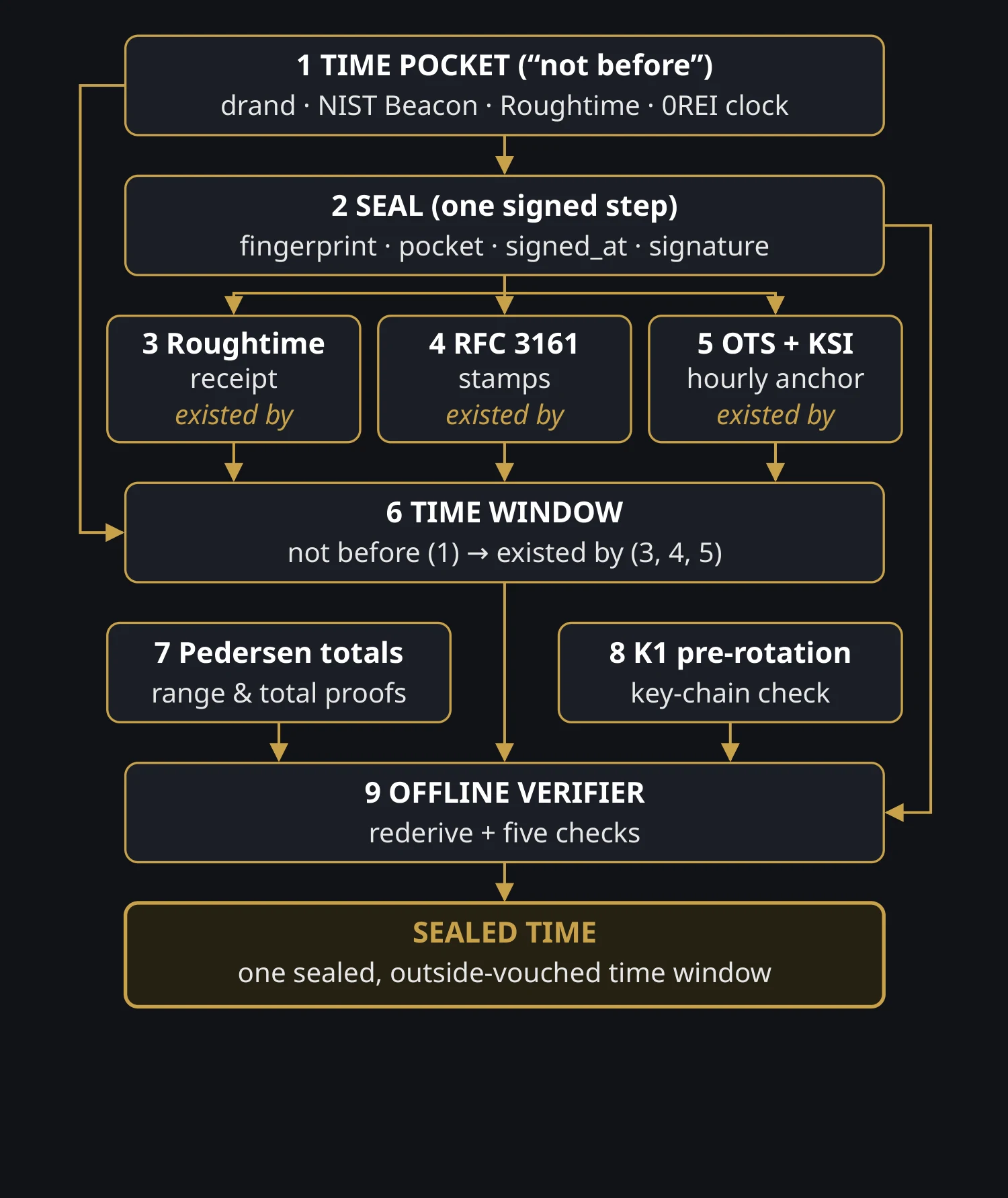
1. The Time Pocket: "not before"
A live bundle of outside time values that 0REI keeps refreshing all day: drand (run by the League of Entropy), a public random value every 3 seconds; the NIST Randomness Beacon, a signed "pulse" every 60 seconds; Roughtime, signed time readings from Cloudflare and Netnod; and 0REI's server clock, synced to NIST. 0REI's hosting clock has been measured within about 50 to 100 milliseconds of NIST.
Nobody can know a drand or NIST value before it is published, so a seal that contains one can't have been made earlier.
In plain English: It works like a photo of someone holding today's newspaper. The photo cannot have been taken before that day's headlines were printed.
2. The Seal: what, when and who in one signed step
When a document is sealed, 0REI does all of this in one step, with no wait: it locks the content inside a Pedersen commitment, takes a plain hash of that box as the seal's permanent fingerprint, locks in the current Time Pocket, records 0REI's own time to the microsecond (signed_at), and signs everything together with 0REI's current key, so no part can be changed later.
It is an atomic seal: payload digest, metadata, time context and key-lineage state in one signed record.
The outside witnesses stamp the plain hash rather than the Pedersen box itself, because hash-based proof is the strongest long-term protection that the content can't be changed.
In plain English: Think of a tamper-evident evidence bag. The item goes in, the bag is sealed with today's dated tag inside, and an officer signs across the seal. Open or alter anything and it shows.
3. Instant Outside Receipt (Roughtime): "existed by" within seconds
The seal's fingerprint goes straight to Roughtime servers run by Cloudflare and Netnod. Within seconds there is a signed outside receipt showing the seal already existed. This receipt is what stops a thief with a stolen key from backdating a seal past the key's revocation.
In plain English: It is like handing a sealed envelope to a neutral clerk who instantly stamps the time on the receipt and gives you a signed copy.
4. Formal Timestamps (RFC 3161): "existed by" with formal receipts
The fingerprint goes to RFC 3161 Time-Stamp Authorities: DigiStamp, DigiCert and FreeTSA. Each returns a signed stamp showing the seal existed by that moment. Stamps arrive in about a minute.
New seals are gathered into a Merkle tree, so one stamp covers a whole batch. Each token is authenticated before a batch is marked anchored. Stamping runs alongside sealing, so a timestamp-service outage never holds up sealing; the batch simply waits for its stamp.
In plain English: It is like having a notary stamp and sign a document, except three independent notaries do it, and one stamp can cover a whole stack of documents at once.
5. Permanent Anchor (OpenTimestamps / Bitcoin + Guardtime KSI): "existed by", permanently, on hashes alone
Once an hour, the fingerprints are rolled up and written into Bitcoin through OpenTimestamps, with Guardtime KSI alongside. Both are built only on hashes, not on digital signatures. OpenTimestamps proofs are checked against Bitcoin block headers.
Because it relies only on hashes, this layer doesn't depend on any signature scheme: future quantum computers are not expected to break hashes the way they could break today's signatures. It is the foundation of 0REI's post-quantum migration. That is also why the witnesses stamp the hash fingerprint from the Seal.
In plain English: It is like carving the document's fingerprint into a public stone wall that the whole world watches and nobody can repaint.
6. The Time Window: one sealed time
The Time Pocket proves the seal wasn't made before a certain point. Roughtime, the RFC 3161 stamps and the Bitcoin anchor prove it existed by a later point. That is five or more independent third parties vouching for the time: drand, the NIST Beacon, Roughtime (Cloudflare and Netnod), DigiStamp, DigiCert, FreeTSA, OpenTimestamps on Bitcoin, and Guardtime KSI.
Combined with the key chain (point 8), the window is what defeats backdating past a key revocation, and it works together with 0REI's signed chain head so the two protections stack.
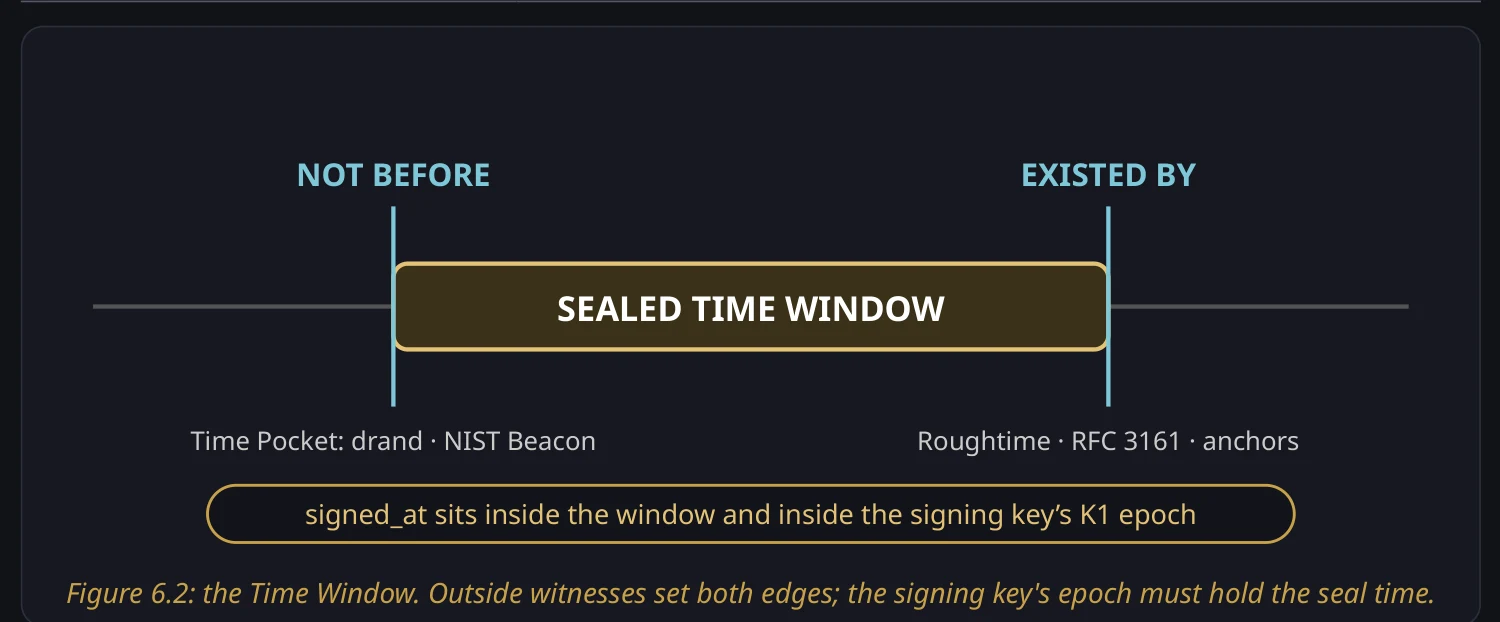
In plain English: Picture bookends. The newspaper in the photo is the left bookend, the stamped receipts are the right bookend, and the seal sits between them.
7. Pedersen Totals: prove totals without opening anything
Range proofs show each hidden value is valid, for example not negative and inside its limit. Total proofs show a set of sealed values adds up to a stated total while every individual value stays private. Aggregates use a minimum set size of five. Customer-held blinding means only the customer can open their own values. A command-line tool builds and checks these proofs.
In plain English: Imagine locked cash boxes on a scale. You can prove the total weight is right without unlocking any single box, and only each owner holds their own key.
8. K1 Key Pre-Rotation: who signed
0REI's signing keys form an unbroken chain that starts at the genesis key from the key ceremony. Each key commits in advance to the next by publishing a hash of the next public key. At rotation, the outgoing key signs a link handing authority to the new key, the new key must match the commitment made in advance, and every link is also signed by the incoming key. Every seal ever signed stays verifiable through the chain, back to genesis.
An attacker can't slip in a substitute key, because it wouldn't match the published commitment.
In plain English: It is like a line of succession announced in advance. Each office-holder names their successor publicly before handing over, so an impostor cannot claim the seat.
9. Offline Verification: anyone can check, offline
Anyone can check a seal with the 0REI Offline Verifier, without trusting 0REI or even contacting it. The verifier works the result out from scratch from the seal itself against pinned roots, and checks five things:
- The fingerprint matches the Pedersen box.
- The Time Pocket values match the public drand and NIST records.
- The Roughtime, RFC 3161 and Bitcoin receipts are genuine.
- The signing key traces through the K1 chain to genesis.
- Any total or range proofs add up.
The verifier supplies no time of its own. It confirms the time evidence from the outside witnesses. Clients never depend on 0REI being online, cooperative or even in business to prove their evidence.
In plain English: It is like a self-checking receipt you can verify at home with a calculator, instead of phoning the shop to ask whether it is real.
The life of one seal
| When | What happens |
|---|---|
| All day, in the background | The Time Pocket refreshes: drand every 3 seconds, the NIST Beacon every 60 seconds, Roughtime readings and 0REI's NIST-synced clock (point 1). |
| At sealing, instantly | Pedersen box, fingerprint, Time Pocket, microsecond time and the current key's signature, all in one step (point 2). This sets "not before". |
| Within seconds | Roughtime returns a signed receipt for the fingerprint (point 3). The first "existed by" is in place. |
| In about a minute | RFC 3161 stamps arrive from DigiStamp, DigiCert and FreeTSA (point 4). |
| Within the hour | The fingerprints are anchored in Bitcoin through OpenTimestamps, with Guardtime KSI alongside (point 5). |
| Result | A Time Window vouched for by five or more independent witnesses (point 6), with private totals (point 7) and a pre-committed key chain (point 8). |
| Any time later, by anyone | The Offline Verifier rederives everything and runs its five checks, air-gapped (point 9). |
Built to keep sealing
Stamping runs alongside sealing. If an outside timestamp service is slow or down, sealing carries on and the batch waits for its stamp, so clients are never held up by a third party.
What the verifier confirms
| Check | Points it confirms |
|---|---|
| 1. Fingerprint matches the Pedersen box | 2 (Seal), 7 (Pedersen) |
| 2. Time Pocket matches public drand and NIST records | 1 (Time Pocket), 6 ("not before" edge) |
| 3. Roughtime, RFC 3161 and Bitcoin receipts are genuine | 3, 4, 5, and 6 ("existed by" edge) |
| 4. Signing key traces through the K1 chain | 2 (signature), 8 (K1) |
| 5. Total and range proofs add up | 7 (Pedersen Totals) |
What the nine points protect against
| Threat | How 0REI handles it |
|---|---|
| Someone with a stolen key backdates a seal, for example to before the key was revoked | The Time Pocket and outside receipts fix the window (points 1, 3, 4, 5, 6), and the key chain records the revocation (point 8). |
| Content changed after sealing | One signature covers everything (point 2), and outside witnesses stamp the fingerprint (points 3, 4, 5). |
| One time witness has a wrong clock | Five or more independent witnesses vouch for the time (point 6). |
| Relying on any single company's clock, including 0REI's | Outside parties set both edges of the window (points 1, 3, 4, 5). |
| Future quantum computers and signature-based receipts | Hash-only anchors (point 5), with witnesses stamping the hash fingerprint (point 2). This is the foundation of 0REI's post-quantum migration. |
| A fake or substituted signing key | Each key is committed in advance and every link is co-signed by the incoming key (point 8). |
| 0REI unavailable or out of business | Anyone can verify with the Offline Verifier, air-gapped (point 9). |
| A timestamp service is down at sealing time | Sealing continues and the batch waits for its stamp. |
| Private values exposed while proving totals | Pedersen hiding and customer-held blinding (point 7). |
In one line
Private contents, provable totals, a key chain that rotates cleanly, and time vouched for by independent witnesses, all checkable by anyone, offline.
"Every 0REI seal sits between two outside proofs. First, it locks in public random values from drand and the NIST beacon that nobody can know in advance, so it can't have been made earlier. Then its fingerprint is stamped by Roughtime within seconds, by formal RFC 3161 timestamp authorities within about a minute, and every hour into Bitcoin, so it provably existed by then. That's five or more independent outside witnesses, not just our own clock. Contents stay private in Pedersen boxes, our keys are pre-committed in an unbroken chain, and anyone can check all of it offline."